
The Mary Kay Inventory Con Game
Written by Carrie
Do you really need all that inventory? Do you really “profit” 50% on inventory you sell? No and no. But they sure make it sound good, don’t they? And yet, it’s all a con game.
Profit Margin
Below is a quick table showing what the true profit margin is from customer sales for a new Mary Kay consultant. We’ll assume that she is selling $300 retail per week. (That’s probably a lot more than the vast majority of consultants sells, but work with me on this.)
Directors and recruiters always parrot the line about making 50% profit on “everything you sell” in Mary Kay. As you can plainly see, there is not a 50% profit to be made.
Below are all the actual costs, including the cost of going to meetings, averaged to $4 per meeting. (Remember all the FREE training you were promised when you signed up, gals? wink, wink) Also added in are supplies and sample products, because you can’t sell without them.

This table assumes that everything is sold at full price. That’s rare. The roll-up bag results in a profit of about $100 instead of $150 because of the great “special” that is usually offered. Suddenly our “profit” has dropped and we haven’t even accounted for any other expenses yet. So if you figure there are roll-up bags sold, the profit margin above will be much smaller.
Paying For Inventory
For every sale made by a consultant, she must replace inventory, pay for supplies and gifts, and then the profits remaining can be used to pay off the initial inventory purchase.
Using our wildly optimistic estimate of sales of $300 retail per week, the below chart shows how long it takes to pay for the initial inventory purchase, using the $348 monthly profit from above. Even with a modest initial inventory of $1,200, you see that it will take about 3 1/2 months to pay that off!

Profit From Recruiting
Okay, you say “Well, what about all the money we make from recruiting?” Glad you asked! Let me break it down for you…
Let’s assume for this example, that a consultant actually recruits 3 new consultants who each come in with a $3600 initial inventory order. That’s unlikely, but let’s assume it for now.
Just how much commission does she stand to make? A recruiter gets anywhere from 4% to 8% commission. These inventory purchases by her recruits would qualify her for 8%, so she would get $864 in commission that month. Sounds good but remember that those consultants likely won’t order much again. If those three consultants each order the minimum the next month, the commission check will be only $27.
The commissions as a recruiter are so inconsistent and so low at 4% to 8%, that they won’t be much help in paying off that initial inventory purchase.
Increasing Sales
So, now what? The only way to do better is by improving her sales. Can the consultant sell $500 a week? Very few are able to do this consistently. But even if the consultant could, here is what the numbers would look like:

In this scenario, profit margin increases very slightly, to 31%. But, you may point out, the profit itself has increased, right? Ummm, yeah, to $628/month. Now, it will only take the consultant almost 6 months to break even if she did the $3,600 inventory. Woo hoo!

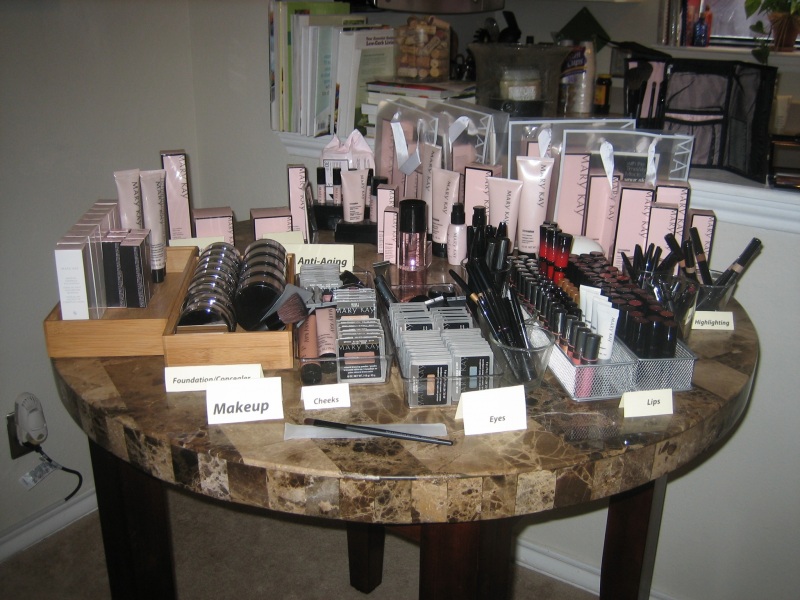
Keep in mind that in Mary Kay, they say you should keep reinvesting in inventory until you have at least $3,600 wholesale on the shelf. That’s considered “profit level” inventory, and you’re not supposed to take any profits until you get to that point. You’re also supposed to keep replacing products once you get there, so you always have at least $3,600 on your shelf.
Except that keeping little to no product on your shelves is actually the most profitable way for any new consultant to run her business.
It makes no economic sense for each consultant to keep her own inventory. In fact, inventory as a business term is only appropriately applicable to the Mary Kay corporate warehouses. It only takes a few business days to receive an order from Mary Kay, and most customers will have no problem waiting that long to receive their product purchase.
And that, my friends, is the Mary Kay inventory con game. Stock inventory at your own risk.




 Visit the
Excellent! I don’t remember seeing it broken down this clearly. Thank you!
I love these breakdowns! My fear is your optimistic example might inspire hope for some recruits.
Here is the one that I push back on the hardest:
“Let’s assume for this example, that a consultant actually recruits 3 new consultants who each come in with a $3600 initial inventory order.”
It is mathematically impossible, in any MLM downline, for the average number of direct downline reps to exceed (or even fully reach) one. If you have three directly under you, there must be another three in your own downline with zero under them. Having 3 directly under you is great, but is not scalable. Someone (in fact most if not all) in your own downline must lose money for you to achieve any meaningful profit.
This is the primary problem in MLMs like Mary Kay. The more one rep makes on commissions, the more their downline must lose to pay for those commissions. There is no way around this, as this is the nature of pay-to-play endless-chain recruiting schemes like Mary Kay.
If selling product was a path to riches, the big moneymakers would be doing it. But they are not. Instead of bragging about their ledger and how much they are netting from sales margins, they show off their highest commission check. Even Mary Kay recognizes “income” by commissions and bonus only, with no regard for true sales margin.
And those commision checks are hardly from sales to outside customers. They are almost entirely from orders placed by their own downline reps.
With MyShop, you don’t even need to have inventory!
The FIRST thing a real company does to increase profit is to REDUCE inventory. “Profit level” is as close to zero as you can get without losing too many sales. If not stocking Raisin Ripple means you lose a couple of sales, you need to figure out how much stocking it is compared to the profit from the two sales a year you make.
Product on the shelves is not an asset, it’s a money-eating liability that goes obsolete, gets damaged and usually has an interest payment attached.