
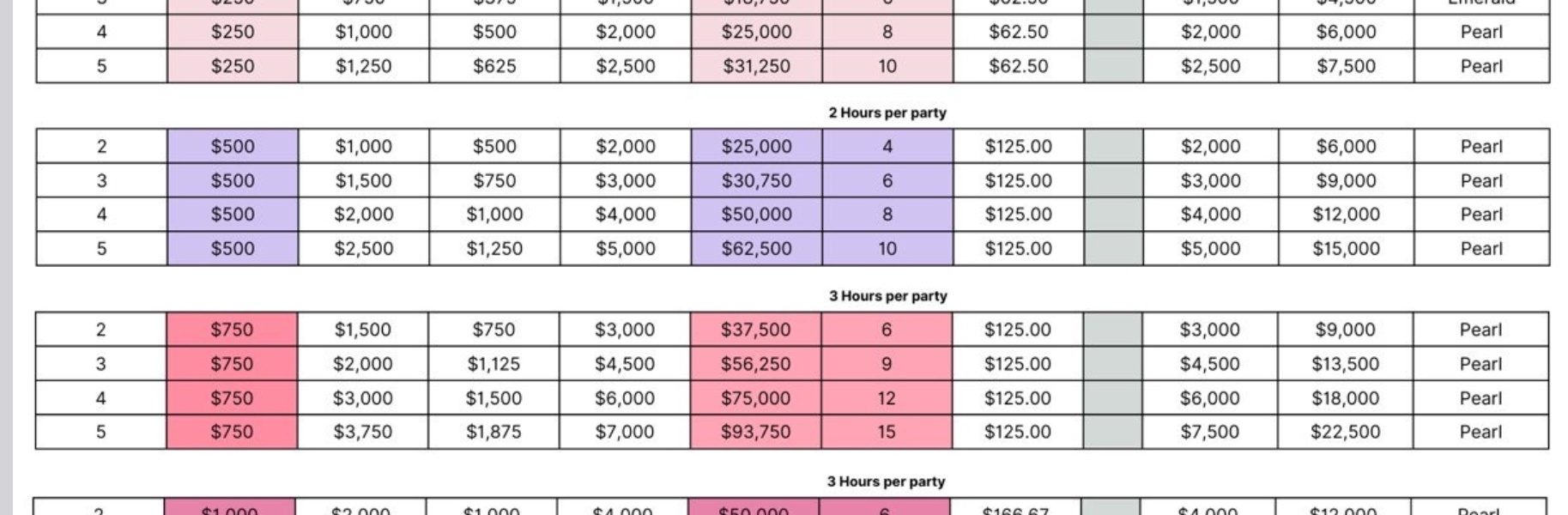
Kitchen Table Party Math
Mary Kay pretends to care about earnings claims made by consultants and directors. (See what they had to say about earnings claims on social media here.) They have to care, because if they don’t, the company can be subject to action by the Federal Trade Commission.
But I would suggest that they don’t do enough to crack down on the earnings claims. They are all over social media. It’s easy to find posts bragging about how much money is made, how much you’re going to make, the free car you can get, and how you can sell a bunch and make a bunch of money.
When I was recruited into Mary Kay in 1999, I was sold a bill of goods like the below Kitchen Table Party Math sheet. They showed me that if I was “willing” to hold ____ parties per week, I would have this much in party sales. Then I’d have a certain amount of reorders and my sales of products would keep growing and growing.
It was all fiction because the numbers were based on a perfect little Mary Kay world that doesn’t exist. You are supposed to assume that you could consistently book a certain number of parties, that all of those parties will actually hold, that enough women will attend, and that they will buy enough products to hit the projected sales figure. Then those customers are supposed to reorder regularly, giving you an ever-growing base of repeat business.
The math makes it look easy, doesn’t it? They tell you that you can sell an average of $250 per party. If you do that and hold 3 parties a week, keeping half of everything you sell, then Mary Kay looks lucrative on paper. This is without even recruiting anyone!
But what happens when half of the parties cancel? What happens when three women show up instead of eight? What happens when they each buy one lipstick? What happens when the hostess doesn’t have any outside orders? What happens when your customers don’t reorder on the schedule Mary Kay says they will? How do you even find the women who are willing to book a party to begin with????
And then there’s the famous “50% profit.” Consultants have been repeating that one forever. Buy for $1, sell for $2, and you’ve made a 50% profit. Except you haven’t made that profit because you still have expenses. Samples, hostess gifts, discounts, freebies, credit card fees, shipping, mileage, meeting costs, website fees, expired products, discontinued products, unsold inventory, and all the other little costs of doing business have to come out of that supposed profit.
The recruiting pitch doesn’t spend much time on those details because the details ruin the fantasy. Instead, the prospect is often encouraged to participate in creating the earnings claim herself. How many parties would you be willing to hold? Two? Great! Let’s plug that into the worksheet. Look how much you could make!
See what happened there? The recruiter didn’t necessarily say, “I guarantee you will earn $X per month.” She simply supplied all the assumptions, walked the recruit through the arithmetic, and let the recruit arrive at the exciting number herself.
That’s still an earnings representation. The entire purpose of the exercise is to show a woman how much money she supposedly could make with Mary Kay.
Not a lot has changed since I was recruited into Mary Kay in 1999. Back then, the fantasy might have been presented on a photocopied worksheet at someone’s kitchen table. Today it can be an Instagram reel, a Facebook post, a TikTok video, or a director posing next to a car and talking about the incredible life Mary Kay has provided for her.
The underlying message hasn’t changed at all. It’s still all about the lies regarding how much money you can make, the freedom you can have, and the success that others have with MK. But it’s all a farce. The results of millions of consultants don’t come anywhere close to the projections, and of course the blame is put on them. You didn’t book enough. You didn’t hold enough appointments. You didn’t follow up enough. You weren’t consistent enough. You didn’t work your business.
Funny how the numbers are perfectly predictable when they’re recruiting you, but completely your fault when they don’t materialize.
If Mary Kay really wants to get serious about earnings claims, it shouldn’t just police a few overly enthusiastic social media posts. It should look at the entire culture of recruiting that teaches women to sell the opportunity with hypothetical income, aspirational lifestyles, cars, prizes, and carefully constructed math.
Because whether the earnings claim is typed into a Facebook post or scribbled onto a worksheet at a kitchen table, the purpose is exactly the same. It’s there to make the opportunity look a whole lot better than it really is. Oh wait… Mary Kay doesn’t stop this because the company benefits from it every single time.



 Visit the
Okay, let’s continue the math. 2 parties per week is 104 parties per year. To average $500 in annual retail sales, you will need 20 guests spending $25 each, on average. That translates to over 2000 new customers every single year…for every IBC! Where will these new people come from? Most people only know 10 or 20 people that might attend something like this…once. Assuming no repeats at the parties for 5 years, the population of the US can only support 36,000 IBCs. Take out the men and that drops to 18,000. Take out minors and you are down to ~13K IBCs. Assume only 1 in 10 women would consider using Mary Kay, and your are down to ~1,350 reps supported by the population of the US having 2 parties per week. Take away those who have already attended an MK party, and the number of willing party participants per IBC approaches zero.
My guess is the average spend per participant is much less than $25 ($15?) and the average party size is closer to 5. I also suspect the average number of parties held is less than 2 per month per IBC.
Given these more realistic numbers, the IBC is looking at closer to $1800 in annual sales, with a sales margin of $900 for the year. Qualifying minimums eat up close to $1000, so unless you guessed perfectly on your quarterly order, your ledger will likely show a loss, on front-loading costs alone! This does not include other costs, such as samples, gifts, party materials, and this also assumes no discount on the product. It also does not consider the cost of a big initial order up front.
Besides, the big moneymakers in MLMs like Mary Kay are not doing so through product sales. Rather, they are recruiting and front-loading their recruits. Retail sales are simply not part of the MK business plan, and are not necessary for the system to function.
Ordering and front-loading provide the true path to riches in MLMs like Mary Kay. Retail sales are simply not part of the equation.
“Ordering and front-loading…”
Oops. Meant to say, “Recruiting and front-loading…”
“To average $500 in annual retail sales…”
Should have read, “To average $500 in actual retail sales…”
Autocorrect strikes again!
Their minimum sold per party is $250, and how many posts do we see bragging about $85… or less. 2 hours per party is nonsense once you figure in all the prep work done beforehand, plus packing up afterwards.
Their pretty pastel spreadsheet is about as realistic as a grade school word problem.
Mary Kay Eyeshadow Stick… $20.00
Colourpop Eyeshadow Stick… $9.00
There’s my math. 🙂
Ok recruiter, this is nice and all that – but can you show me how your sheet looks with using your actual numbers?
Well… You know… Individual results may vary and all. This is about YOUR business, not MINE! You get to set your own goals and fly as high as you want! You can even pass me up! That’s why MK isn’t a pyramid.
My favorite part is at the bottom. All of these are claimed to be a “waste of time that could be spent on MK”. Except… it sounds an awful lot like a consultant, as PinkTruth repeatedly shows.
“Women spend more hours per week in: unpaid overtime, 2nd job, wasted/unproductive time, ‘helping’ (recruiting) others, doing things YOU CAN DO TOO, social media.”